Supporting renewable energy and providing cheaper power continue to fuel the city of Arcata’s interest in purchasing and re-selling electricity to its residents. Becoming a Community Choice Aggregation â€" or CCA â€" has been under discussion since at least 2007.
While the city of Arcata’s size is impractical for purchasing electricity on its own, city leaders are contemplating joining Sonoma Clean Power, a CCA that began providing power last year to the residents of Santa Rosa, Sonoma, Windsor, Cotati, Sebastopol and Cloverdale under the auspices of the county of Sonoma. The concept, Arcata City Manager Karen Diemer said, is aligned with a city goal of energy resiliency.
Under CCAs â€" allowed in California with legislation in 2002 â€" public power agencies purchase electricity from sources of their choice and sell that power to customers in the affected area while the existing power company delivers the power. Residents in the area have the right to opt out and remain with the current power provider when the CCA is established.
Redwood Coast Energy Authority Executive Director Matthew Marshall said the organization’s board directed RCEA staff to explore the possibility of establishing a local and independent CCA last spring. In March, he said, a recommendation will be forwarded to the board to continue the process.
The next step would be getting the backing of the Humboldt County Board of Supervisors, he said. Then it’s working out the details â€" which communities would be involved, how much power would be needed, selecting power vendors and working out the administrative details. Among those details, he said, are determining priorities. The emphasis could be on renewable energy or on low prices or a mixture of both, Matthew Marshal said.
Ideally, he said, the county and all of the cities would participate knowing that each customer had the option to opt out. It’s possible a locally-based CCA could be up and running in one to two years.
Advertisement
Since Marin took the challenge of forming the first CCA some five years ago, the program has interest from throughout the state. Marin Energy was the first CCA in 2010, Sonoma Clean Power in 2014 and several other governmental entities are taking definitive steps to set up their own CCA. The Los Angeles city of Lancaster will launch a CCA in May, according to Shawn Marshall, executive director of Lean Energy, a national advocacy organization that provides information and consultation on CCAs.
Several others are actively exploring the possibility and have committed funds to the effort, including Alameda County, San Mateo County, a consortium of cities in Silicon Valley, San Francisco, San Diego and a couple cities in Santa Clara County, she said. And still more are examining the possibility at an uncommitted level: seven beach communities in Los Angeles County, San Luis Obispo County and Santa Barbara County.
Both RCEA and the city of Arcata have a couple of options in proceeding: negotiating to join an existing CCA or forming an independent CCA. There are advantages in both, Shawn Marshall said. Joining an existing CCA would likely be more expedient as the structure is in place. An independent CCA, however, would have complete control in choosing which power producers to purchase electricity from and where to invest any monies made.
The actual transfer of power purchased by Sonoma goes like this: the power is entered into an overall grid with certain amounts designated for customers of Sonoma Energy. Imagine this continuous loop of power running through the state â€" each CCA adds to that pool and its customers withdraw a like amount from the pool. Shawn Marshall likened the process to depositing $100 into one’s account one day in San Francisco and withdrawing the same amount in Los Angeles the next day.
Customer savings range from 4 to 10 percent for those in the Marin and Sonoma CCAs, Shawn Marshall said, with commercial customers saving more.
The process can be time-consuming.
Arcata Energy Committee member Jim Zoellick said the city first began considering the possibility in 2007, but held back knowing that the concept hadn’t yet been tried in California. The question now, he said, is whether the city waits for the establishment of a broader CCA that includes other North Coast communities or joins the existing one in Sonoma.
Jessie Faulkner can be reached at 441-0509.

 Hitachi, Ltd. (TYO:6501), which is headquartered in Tokyo, is a Japanese conglomerate with an incredibly diversified business portfolio. Various business segments within which Hitachi operates include electronic systems and equipment, automotive systems, telecommunications systems and social infrastructure.

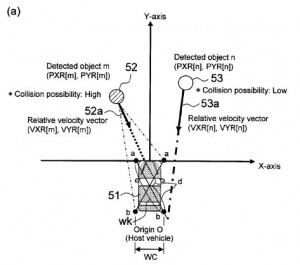 in the automotive world as reported by Thomson Reuters, for the recognition of pedestrians on or near the road is at the center of U.S. Patent No. 8924140, entitled External Environment Recognition Device for Vehicle and Vehicle System Using Same. The patent protects an external environment recognition device for a vehicle that recognizes a vehicle’s external environment based on detected object information of a plurality of objects in front of a host vehicle, image information of an image in front of the host vehicle and a means for setting a predicted course based upon host vehicle information derived from a detected status of a host vehicle. This invention is intended to address delays in processing recognition of pedestrians by reducing the processing load required to detect pedestrians and other obstacles for collision avoidance.
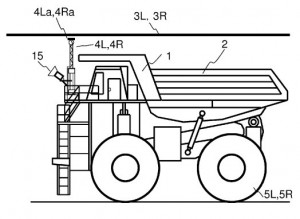 driven from electrical power supplied by trolley wires and not with energy supplied by an engine. This electrically driven vehicle protected by the patent includes a trolley wire detection device for detecting a trolley wire from below while the vehicle is traveling and a control device which controls a yaw moment to the vehicle so that the vehicle travels while tracing the trolley wire. This invention allows a hybrid dump truck to stay in-lane with the trolley wires supplying power to the truck without requiring a human driver to judge whether or not the truck is properly below the trolley wires.
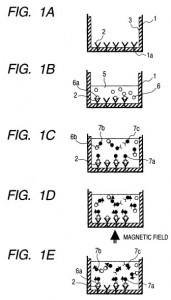 We also took note of a couple of medical innovations brought to the world by Hitachi, one of which is outlined within U.S. Patent No. 8945469, entitled Magnetic Immunoassay System. This patent protects a magnetic immunoassay system which measures a remnant magnetic signal for detecting an antigen contained within a sample; the system utilizes a nonmagnetic reaction chamber with a surface covered with capturing antibodies for binding antigens in a sample, a mechanism for moving the reaction chamber and a magnetic sensor measuring the magnetic signals from the chamber for sending a signal to a processor to detect magnetic particles binding to the group of collected antigens. The resulting immunoassay system has an improved detection sensitivity for detecting DNA, environmental toxins or cancer cells than conventional systems utilizing optical fluorescent enzymes and not magnetic forces.
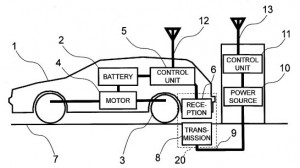 coverage of auto tech from the 2015 Consumer Electronics Show, and Hitachi has its own entry into this sector with U.S. Patent Application No. 20150002091, filed under the title Wireless Charging System. The wireless charging system claimed here includes multiple winding portions formed by winding an electric wire and sandwiched together with the use of a pair of magnetic members. This wireless charging system configuration achieves an improved charging efficiency resulting from an increased coefficient of magnetic coupling between a transmitting unit and a receiving unit during wireless charging. An improved configuration for a power conversion apparatus used by an electric vehicle is the subject of U.S. Patent Application No. 20150022974, which is titled Power Conversion Apparatus and Electric Vehicle. The power converter apparatus claimed here includes a power module with a power semiconductor element, a driving circuit board that drives the power semiconductor element, a control circuit board that controls the semiconductor element and a metal base disposed between the driving and control circuit boards. This invention includes a cooling jacket and heat releasing parts that provides adequate cooling while reducing the dimensional size and manufacturing costs of the power converter apparatus.
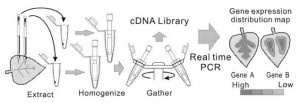 Improved methods of analysis for identifying gene expressions within plant tissue have also been developed by Hitachi and are the focus of U.S. Patent Application No. 20150018243, which is titled Plant Tissue Sampling Method and Plant Gene Analysis Method. The innovation is designed to enable a system through which a fragment of plant tissue can be quickly sampled and the gene expression state within the tissue fragment is quickly preserved for comprehensive analysis. This Hitachi patent application would protect a method of sampling a plant tissue section involving the steps of inserting a first gel layer into a needle, arranging a plant tissue on a second gel layer, passing the needle through the plant tissue and second gel layer and sampling a section of plant tissue in the needle.
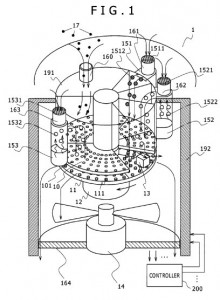 The Hitachi mindset of “social innovation†is clearly on display in the public health technology that would be protected by U.S. Patent Application No. 20150010902, entitled Apparatus and Method for Monitoring Airborne Microorganisms in the Atmosphere. This invention is intended to aid in the detection of airborne pathogens, like influenza, directly from the atmosphere and works both continuously and in a short period of time. The patent application claims an apparatus for monitoring airborne microorganisms including a chassis with a fan for flowing air towards an interior segment, a perforated plate disposed at the chassis with multiple nozzles for focusing split air flows, a capturing plate with a plurality of trapping surfaces and an optical detection part for fluorescence generated from the microorganisms on the capturing plate’s trapping surfaces.


 .
.